7 Reasons Your Salad Tastes Better in a Wide Bowl Than a Deep One
Quick Answer: A wide shallow bowl gives you more surface area and a shorter stack, which means dressing coats more evenly, the leaves at the bottom are not crushed by the weight above them, and aromatics reach your nose before the fork reaches your mouth. A deep bowl concentrates dressing at the bottom, compresses the greens, and traps the aroma. Switching bowls is the cheapest salad upgrade available and it changes the result more than most ingredient swaps.
Restaurant kitchens plate salads in wide vessels almost without exception.
That is not an aesthetic decision, and here are the seven reasons why.

1. Dressing distributes by surface area, not by volume
This is the mechanical heart of it.
When you toss a salad, the dressing spreads across whatever leaf surfaces it touches on the way. In a wide bowl, each toss moves leaves across a large flat area and every leaf passes through the dressing zone repeatedly. In a deep bowl, the leaves at the top circulate and the ones at the bottom sit in a pool.
The result is a salad with two distinct populations: over-dressed leaves at the bottom and dry ones at the top. You then add more dressing to fix the dry ones, which makes the bottom worse.
The practical test: eat three forkfuls from different depths of a salad tossed in a deep bowl. If they taste noticeably different, this is why.
A useful rule of thumb — your bowl should be at least twice as wide as the salad is deep when everything is in it. Most home salad bowls fail that test badly.
2. Weight crushes the leaves at the bottom
Greens are structurally fragile in a way that only shows up under load.
A head of lettuce torn into a bowl weighs very little, but the cumulative weight in a deep stack is enough to bruise the leaves at the bottom. Bruised leaves release moisture, and released moisture dilutes the dressing and starts the sogginess clock early.
This is worse with tender greens. Butter lettuce, mâche and young spinach crush under a few inches of anything. Sturdier leaves like romaine and kale tolerate depth better, which is why deep-bowl salads so often end up being made from the toughest greens available — people gravitate towards the ones that survive their equipment.
Add heavy toppings and the problem compounds fast. A handful of cherry tomatoes, some cucumber and a scoop of chickpeas sitting on delicate greens for ten minutes does real damage.
In a wide bowl the stack is two or three inches tall and nothing gets crushed.
3. Aroma reaches you before the food does
A large share of what you experience as flavour is smell, and bowl geometry decides how much of it arrives.
Most of what we call taste comes through the nose rather than the tongue — the tongue handles a handful of basic qualities and the nose handles nearly everything that makes a dish specific. Aromatic compounds from herbs, good olive oil, vinegar, alliums and citrus are volatile, meaning they lift off the surface into the air.
A wide bowl presents a large surface for those compounds to leave from, and it sits open in front of you. A deep bowl has a small opening relative to its volume and traps most of the aroma below the rim.
This is the same reason wine glasses are wide at the bowl and narrower at the rim, and the reason a deep takeaway container of salad smells of almost nothing until you tip it into something else.
If your salads taste flat despite good ingredients, this is one of the more likely culprits and one of the easiest to test.
4. You can actually see what is happening
A practical reason that matters more than it sounds.
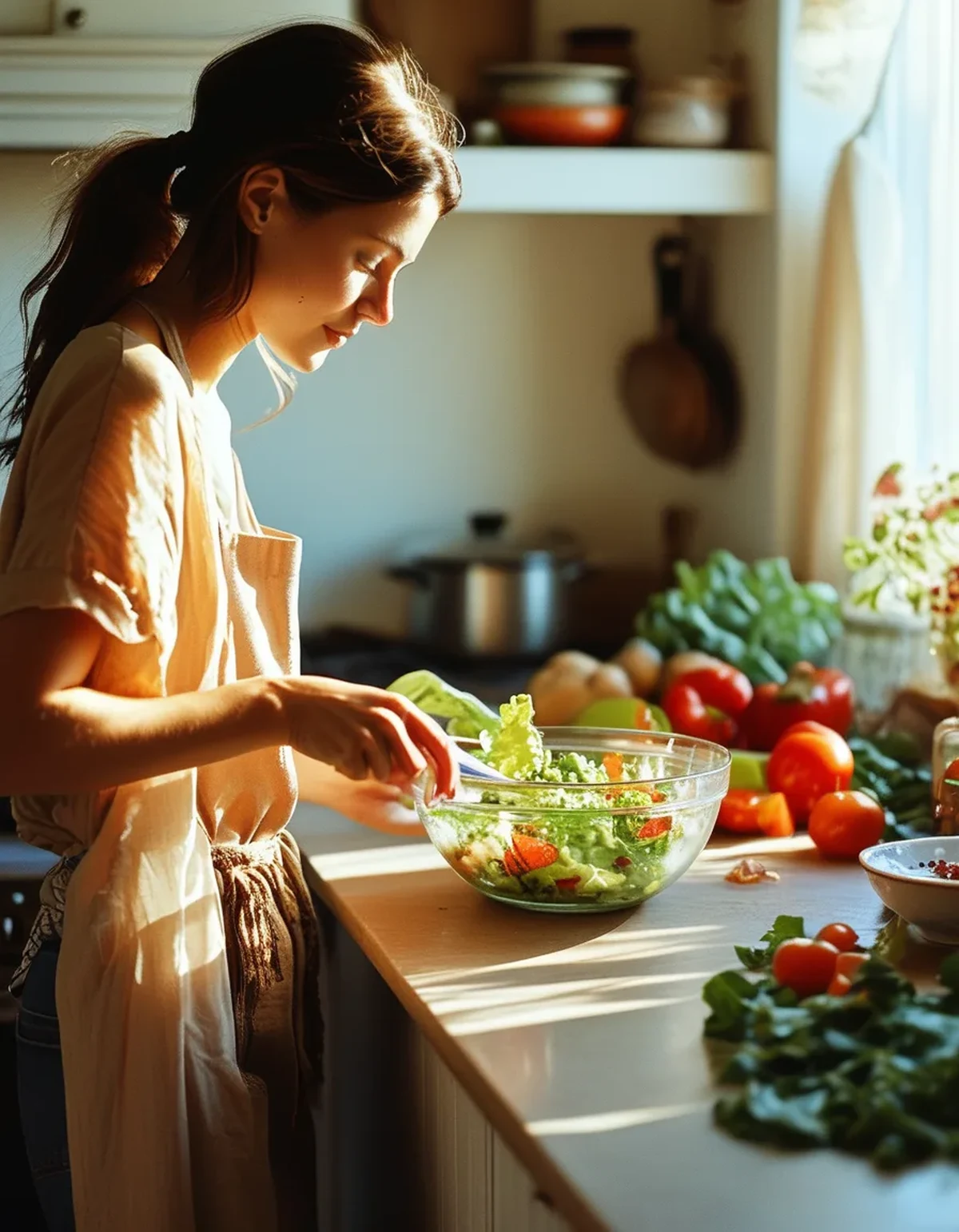
In a wide bowl you can see the distribution of everything — whether the dressing has coated evenly, whether the tomatoes have all ended up in one corner, whether there is a dry patch. You correct as you go.
In a deep bowl you are working blind below the top inch. Most people over-dress deep salads for exactly this reason: the visible layer looks dry, so more dressing goes in, and the invisible layer is already swimming.
Visibility also affects seasoning. Salt needs to be distributed, not dumped, and you cannot judge distribution you cannot see. A wide bowl lets you salt in two or three passes with a toss between each, which is how it is done professionally.
Try this once: dress and season a salad in a wide bowl using half the dressing you would normally use, tossing between additions. Most people find they stop before reaching the amount they used to consider standard.
5. Tossing works instead of stirring
There is a real difference between the two motions, and the bowl decides which one is available.
Tossing lifts leaves and lets them fall back through the dressing, coating them from all sides with minimal mechanical stress. Stirring drags leaves against each other and against the bowl, which bruises them and pushes the dressing downward rather than distributing it.
A deep narrow bowl only permits stirring. There is nowhere for the leaves to go but around, and around means friction.
A wide bowl lets you use the proper motion — two hands or two large spoons, lifting from the bottom and folding over, four or five times. It takes about fifteen seconds and does more for the final result than the quality of your vinegar.
Wooden or silicone tools help too, since metal edges cut leaves that a rounded edge would move. But the bowl shape is the limiting factor: even the right tool cannot toss in the wrong vessel.
Reasons 6 and 7: temperature, and how much you serve yourself
6. Temperature evens out faster
Salads taste better slightly cool rather than cold, and shape controls the transition.
Cold blunts flavour perception — this is well established and it is why a fridge-cold tomato tastes of considerably less than a room-temperature one. A salad taken straight from the fridge is muted for the first several minutes.
A wide shallow salad warms up towards a useful temperature far faster than a deep one, simply because of the surface-to-volume ratio. Five to ten minutes in a wide bowl brings a fridge-cold salad into a range where the aromatics are actually volatile. The same salad in a deep bowl has a cold core for considerably longer.
The fat in the dressing matters here too. Olive oil is noticeably thicker when cold, and thick dressing does not coat — it clings in clumps. Letting a dressed salad sit in a wide bowl for five minutes before eating lets the oil loosen and spread, which frequently fixes a salad that tasted unevenly dressed straight after tossing.
7. It changes how much you serve yourself
The least technical reason and possibly the most useful.
A wide bowl presents a salad as a dish rather than as a side. The same quantity of greens looks generous spread wide and looks meagre packed into a deep bowl, and people serve and eat accordingly.
There is a reasonable body of work on how vessel size and shape influence how much people serve themselves and how satisfying they find a portion. The effect is not enormous but it is real, and it works in a helpful direction for vegetables — a salad that looks like a meal gets eaten like one.
It also encourages better composition. A wide surface invites you to distribute toppings across it rather than piling them, which means each forkful gets some of everything instead of three forkfuls of leaves followed by a mouthful of feta.
Which is the whole point of a salad — the combination in each bite rather than the ingredients in the bowl.
This is general information about food preparation, not nutritional or medical advice.
FAQ: Salad Bowl Questions, Answered
What size should a salad bowl actually be?
For two people, look for something around 28 to 32cm wide and no more than 8 to 10cm deep. A large dinner plate with a slight rim works better than most bowls sold as salad bowls.
Does the material matter?
Less than the shape. Wood is traditional and pleasant to toss in; ceramic and glass are fine. Metal is the only mild negative, since it conducts cold and can react faintly with very acidic dressings over time.
Can I toss in a wide bowl and serve in a deep one?
Yes, and it captures most of the benefit. Tossing is where the bowl shape does its most important work. Serving in something deep only costs you a little aroma.
What about meal-prep containers?
Those are storage, not serving vessels, and the depth is unavoidable. Keep the dressing separate, and tip the contents into a wide bowl or onto a plate before dressing. It takes ten seconds and it is the single biggest improvement available to a prepped salad.
Is this why restaurant salads taste better?
It is one of several reasons, alongside more salt, more acid, and dressing applied by tossing rather than pouring. The vessel is the part you can copy for free.
TL;DR:
- Dressing distributes by surface area, so wide bowls coat evenly and deep bowls pool at the bottom
- Depth crushes the leaves underneath, releasing moisture and starting the sogginess early
- A wide surface lets aroma reach your nose, and most of what you taste is smell
- Wide bowls permit tossing rather than stirring, which coats without bruising
- Shallow salads warm out of fridge-cold faster, which unmutes the flavour
Before you buy better vinegar, try your usual salad on a large dinner plate instead of in a bowl. It is a free experiment and most people do not go back.
Keep Reading
This article is for general informational purposes only and is not medical advice. Always consult a qualified health professional for guidance specific to you.