7 Salad Mistakes That Only Show Up Once Produce Turns to Fall
Quick Answer: Autumn leaves are sturdier and less absorbent than summer ones, autumn vegetables are denser, and everything is served colder. That means more dressing, applied earlier, with more acid and more salt than a summer salad needs — and the reverse of almost every rule you learned in July.
The salad that was perfect all summer has started tasting flat and looking heavy.
You changed nothing. The produce changed everything.
Here are the seven places summer technique breaks down, and what replaces it.

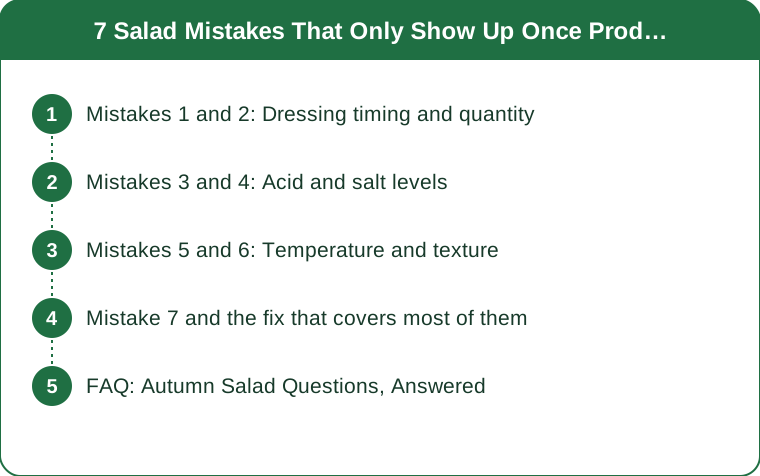
Mistakes 1 and 2: Dressing timing and quantity
1. Dressing at the last second
Summer leaves are thin-walled and full of water, which is why dressing them early makes them collapse. Autumn leaves — kale, radicchio, escarole, chicory, mature spinach — have thick cell walls and hold structure for far longer.
These leaves actually improve with 10 to 20 minutes in dressing. The acid begins to break down the toughness that makes them chewy, and the difference between dressing kale immediately before serving and 15 minutes ahead is the difference between a salad people eat politely and one they finish.
2. Using the same amount of dressing
Sturdy leaves have a waxier surface and hold less dressing per gram than tender ones. The same two tablespoons that coated a summer bowl slides off an autumn one and pools at the bottom.
Increase by roughly half. And massage rather than toss for the toughest leaves — 60 seconds of working the dressing in by hand does more than any amount of tossing with tongs. You will see the leaves change color slightly and reduce in volume by roughly a third; that visible change is the signal to stop, and it is a more reliable guide than counting seconds.
One caveat worth stating: this applies to kale, collards, and mature chard. Radicchio and endive should be dressed but not massaged, because their bitterness intensifies when the cell walls are broken down aggressively.
Mistakes 3 and 4: Acid and salt levels
3. Keeping the summer acid ratio
The standard 3:1 oil to acid vinaigrette is built for delicate produce. Autumn ingredients — roasted squash, beets, apples, sturdy leaves, nuts, hard cheeses — are sweeter, fattier, and more assertive, and they flatten a 3:1 dressing completely.
Move to 2:1 for autumn bowls. It will taste sharp on a spoon and correct on the plate, which is a reliable sign you have it right.
4. Under-salting because the ingredients seem flavorful
Cold suppresses perceived saltiness, and autumn salads are usually served colder than summer ones because they contain refrigerated roasted vegetables straight from the fridge.
There is a compounding effect here that catches people out. Roasted vegetables absorb salt during roasting and taste correctly seasoned while warm, then read as under-seasoned once chilled — so a bowl assembled from properly seasoned components can still land flat. Taste the roasted element cold before you build, not out of the oven.
Salt the components separately rather than the finished bowl. Salted roasted squash, salted dressing, and lightly salted leaves produce a seasoned salad; salt sprinkled over the top of a cold assembled bowl produces salty spots and bland ones.

Mistakes 5 and 6: Temperature and texture
5. Serving everything at fridge temperature
This is the biggest single fault in autumn salads and the easiest to fix. Roasted vegetables straight from the fridge are firm, muted, and greasy on the palate because the fat in the dressing sets against them.
Let roasted components come to room temperature for 20 minutes, or warm them briefly. A salad with room-temperature squash and cold leaves is a far better dish than one where everything is the same cold temperature, and the contrast is the point.
6. Losing the crunch element
Summer salads get crunch for free from cucumber, raw peppers, and crisp lettuce. Autumn bowls are full of soft roasted things and chewy leaves, and without a deliberate crunch they read as heavy.
Add one, always: toasted nuts, seeds, croutons, or thinly sliced raw fennel or apple. Toast the nuts yourself in a dry pan for three minutes — the difference between raw and toasted is enormous and the effort is negligible.
The crunch also needs to go in last and stay dry. Toasted nuts tossed through a dressed bowl fifteen minutes before serving are soft nuts by the time anyone eats them, which is the most common way this fix gets undone by the person who applied it.
Mistake 7 and the fix that covers most of them
7. Building it in the same order
Summer assembly is leaves first, everything on top. That works when the leaves are delicate and the toppings are light.
Autumn assembly should be inverted: dressing in the bowl first, then the sturdiest leaves massaged into it, then the roasted components, then the crunch, then anything delicate. This gets dressing where it is needed and keeps the crunch out of contact with moisture until the last moment.
The single change that fixes the largest number of these at once is dressing the bowl instead of the salad. Put the vinaigrette in the empty bowl, add the toughest ingredients, work them in, then build upward. It solves under-dressing, uneven distribution, and the pooling problem in one motion, and it takes no extra time.
There is a sequencing detail inside this that matters as much as the order itself. Work the dressing into the sturdy leaves fully before any other ingredient enters the bowl. Once roasted squash or soft cheese is in there, further massaging destroys them, so the window for getting the leaves right is before anything fragile arrives. Thirty seconds of attention at that point determines whether the finished bowl is evenly seasoned or a mix of over-dressed and bare.
One more thing worth knowing: autumn salads keep. A dressed kale-based bowl is genuinely good the next day, which is not true of anything you made in July. Make double.
FAQ: Autumn Salad Questions, Answered
How far ahead can I dress a fall salad?
Sturdy leaves like kale and radicchio hold up for two to four hours dressed, and are often better after 20 minutes. Add crunch elements and anything delicate at the last minute.
What is the best all-purpose autumn dressing?
A 2:1 vinaigrette with olive oil, apple cider vinegar, a teaspoon of Dijon, a small amount of maple or honey, and generous salt. The mustard emulsifies and the touch of sweetness bridges roasted vegetables and sharp leaves.
Do I need to remove kale stems?
For raw salads, yes — they stay tough regardless of massaging. Slice them thinly and roast them separately if you do not want to waste them; they crisp well and become a crunch element.
TL;DR:
- Autumn leaves are sturdier, so dress 15 to 20 minutes ahead and use about half again as much dressing.
- Shift to a 2:1 oil-to-acid ratio and salt each component rather than the finished bowl.
- Let roasted vegetables come to room temperature and always add a deliberate crunch.
- Build in reverse: dressing in the bowl first, toughest ingredients massaged in, delicate things last.
Every rule that made summer salads work was written for produce with high water content and thin cell walls. October produce is the opposite on both counts, which is why doing the same thing produces a worse result — and why the fix is mostly a matter of doing everything earlier and more assertively.
Keep Reading
This article is for general informational purposes only and is not medical advice. Always consult a qualified health professional for guidance specific to you.