7 Mistakes That Make Homemade Dressing Taste Like It Came From a Bottle Anyway
Quick Answer: Homemade dressing usually tastes flat or ‘bottled’ due to an off-balance oil-to-acid ratio, skipping emulsification, using dull or old vinegar, under-salting, or missing an aromatic element like garlic or mustard — fixing the ratio and emulsion technique alone resolves most of the problem.
The ingredients are objectively fresher than anything in a bottle, and yet the finished dressing somehow tastes flat, thin, or eerily similar to the store shelf version — which usually means one or two small technical mistakes are canceling out all that fresh-ingredient advantage.

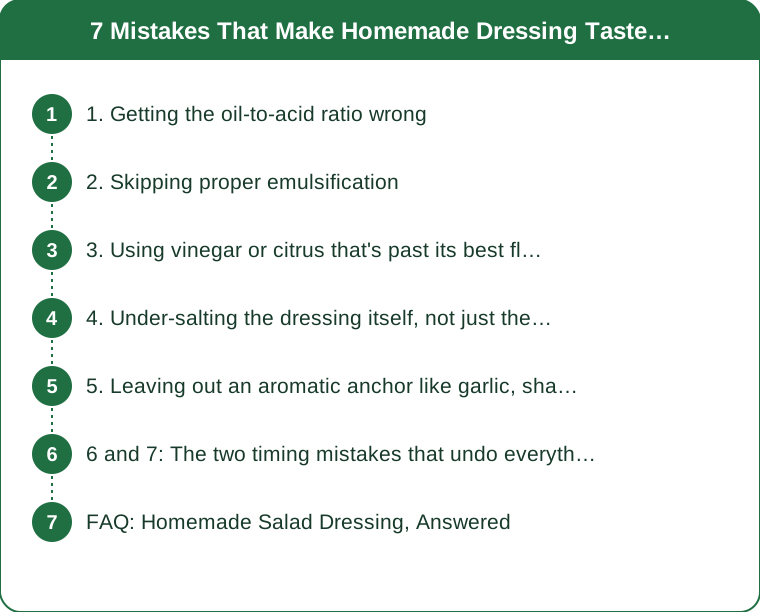
1. Getting the oil-to-acid ratio wrong
The classic starting ratio is roughly three parts oil to one part acid (vinegar or citrus), and dressings made with too much oil taste greasy and muted while too much acid tastes sharp and thin; starting at 3:1 and adjusting slightly to taste from there produces a far more balanced result than guessing or eyeballing without a reference point.
2. Skipping proper emulsification
Simply stirring oil and vinegar together leaves them separated and inconsistent bite to bite, while actually emulsifying — whisking vigorously while slowly streaming in the oil, or shaking hard in a sealed jar — binds the two into a cohesive, creamy-textured dressing that coats greens evenly and tastes more integrated rather than like oil and acid taken in separate mouthfuls.
3. Using vinegar or citrus that’s past its best flavor
Vinegar doesn’t spoil the way perishables do, but its bright acidity does mellow and dull over a long time once opened, and citrus juice loses brightness within hours of squeezing; using a vinegar that’s been open for years or juice squeezed well ahead of time quietly saps the acidic punch that makes dressing taste alive.

4. Under-salting the dressing itself, not just the salad
Salting greens separately after dressing is common, but the dressing itself needs its own adequate salt to taste balanced on its own — a dressing that tastes flat when tasted straight off a spoon will taste flat on the salad too, since salt sprinkled only on leaves doesn’t fully integrate into every bite the way salt mixed into the dressing does.
5. Leaving out an aromatic anchor like garlic, shallot, or mustard
Most memorable dressings include a small aromatic or emulsifying anchor — a little Dijon mustard, minced shallot, or garlic — that store-bought dressings almost always include for exactly this reason; skipping it in a homemade version leaves out a flavor layer that’s easy to miss is even part of what makes bottled dressing taste ‘complete.‘
6 and 7: The two timing mistakes that undo everything else
6. Not tasting and adjusting before serving
A dressing made once and poured without a final taste test skips the adjustment step that separates good dressings from great ones — a pinch more salt, a small splash more acid, or a touch more oil at the end, tasted directly, catches imbalances that following a recipe exactly sometimes misses due to ingredient variation.
7. Making dressing too far ahead without accounting for flavor mellowing
Freshly made dressing often tastes sharper right after mixing and mellows somewhat after resting, which is fine and often desirable, but making it far in advance without re-tasting before use can mean serving a version that’s mellowed past its ideal balance — a quick taste and adjustment right before serving accounts for that shift.
FAQ: Homemade Salad Dressing, Answered
What’s a good starting ratio for a beginner making vinaigrette for the first time?
Three parts oil to one part acid, with a small spoon of Dijon mustard as both flavor and emulsifier, is a reliable, forgiving starting point that can be adjusted to taste from there.
Does the type of oil used make a noticeable difference?
Yes — a decent quality extra virgin olive oil brings noticeably more flavor than a neutral oil, though very strong, bitter olive oils can also overpower a delicate dressing, so a mild-to-medium olive oil often works best as a default.
How long does homemade dressing actually keep in the fridge?
Most vinaigrette-style dressings keep about one to two weeks refrigerated in a sealed jar, though the oil may solidify when cold and needs to sit at room temperature or get a quick shake before use.
TL;DR:
- A roughly 3:1 oil-to-acid ratio is a reliable starting point most homemade dressings skip
- Proper emulsification (not just stirring) creates a cohesive texture that coats greens evenly
- Salting the dressing itself, not just the greens, matters for overall balance
- An aromatic anchor like mustard, garlic, or shallot fills a flavor gap store-bought dressing rarely skips
Homemade dressing tasting like the bottled version usually isn’t a fresh-ingredients problem — it’s one or two fixable technique gaps, and closing them is what finally makes scratch-made taste like it.
Keep Reading
This article is for general informational purposes only and is not medical advice. Always consult a qualified health professional for guidance specific to you.