7 Reasons Your Homemade Dressing Separates and Restaurant Dressing Does Not
Quick Answer: Oil and vinegar separate because nothing is holding them together. Restaurant vinaigrettes contain an emulsifier, almost always mustard, sometimes egg yolk, honey, or miso, which coats the oil droplets and stops them merging back together. Add a teaspoon of Dijon per quarter cup of oil, add the oil slowly while whisking rather than all at once, and use a jar and shake it hard if whisking is not working. A properly emulsified vinaigrette holds for days in the fridge.
This is one of the few kitchen problems with a genuinely complete answer, and it takes about ninety seconds to fix permanently.
This blog has covered why restaurant salads taste better, why store-bought salad kits wilt fast, and warm salads. This is the dressing mechanics, which is the single biggest gap between a home salad and a restaurant one.

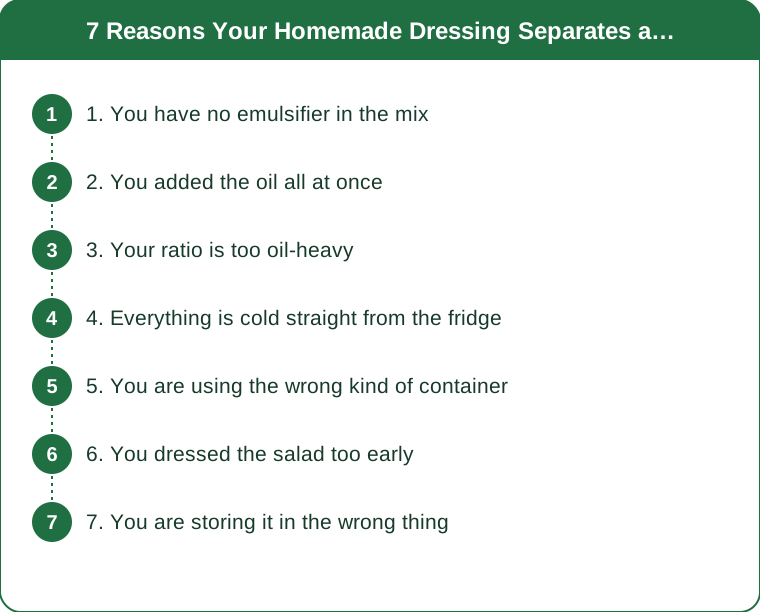
1. You have no emulsifier in the mix
Oil and water repel each other, and vinegar is mostly water. Whisking breaks the oil into tiny droplets suspended in the vinegar, but nothing keeps them apart, so they find each other and merge back within minutes.
An emulsifier is a molecule with a water-loving end and an oil-loving end. It parks at the boundary of each oil droplet, and the water-loving ends facing outward repel each other, keeping droplets from merging.
Mustard is the standard answer and it is remarkably effective. Mustard seeds contain mucilage, which is a powerful natural emulsifier. A teaspoon of Dijon per quarter cup of oil is the working ratio and it barely changes the flavour.
Other options that work: an egg yolk, which is what makes mayonnaise and Caesar dressing stable; honey or maple syrup, which work partly through emulsification and partly through viscosity; miso paste; tahini; and a small amount of Greek yoghurt.
This single change fixes the majority of separating dressings. If you make one adjustment from this whole list, make it this one.
2. You added the oil all at once
Emulsions form by breaking oil into small droplets, and you cannot break a large volume into small droplets in one go. Pouring the whole quarter cup in and then whisking produces large droplets that merge immediately.
Add the oil in a thin stream while whisking continuously. Each small amount gets fully broken up and stabilised before more arrives, and the emulsion builds progressively.
The first tablespoon matters most. Add that one drop by drop if you are making something rich like a Caesar. Once the emulsion has formed, the rest can go in faster.
A jar is the shortcut if you do not want to whisk. Put everything in a jar with a tight lid and shake hard for 30 seconds. Shaking generates far more shear force than most people’s whisking, which is why the jar method works so well for people who find whisking unreliable.
An immersion blender is the overkill option and it works perfectly. It produces droplets far smaller than hand whisking can, and the resulting emulsion is close to unbreakable.
3. Your ratio is too oil-heavy
The classic three parts oil to one part vinegar is a flavour guideline, not a stability guideline. More oil means more droplets to keep separated, which makes the emulsion harder to hold.
Two to one is more stable and, for most people, tastes better anyway. Restaurant dressings are frequently more acidic than home cooks expect, which is a large part of why restaurant salads taste brighter.
If you want a high oil ratio, increase the emulsifier proportionally. A three-to-one dressing needs more mustard than a two-to-one one, not the same amount.
Very acidic vinegars need less dilution than mild ones. A sharp white wine vinegar at two to one can be aggressive; a mellow rice vinegar or a good balsamic at two to one is balanced. Taste and adjust rather than following the ratio blindly.
A note worth making: salt goes in the vinegar, not at the end. Salt dissolves in water and not in oil, so adding it to the vinegar first means it disperses properly. Salt added at the end sits as undissolved crystals.

4. Everything is cold straight from the fridge
Cold oil is more viscous and harder to break into small droplets. An emulsion made with fridge-cold ingredients is measurably less stable than one made at room temperature.
Olive oil in particular solidifies partially at fridge temperature. The cloudiness you see in a chilled bottle is real crystallisation, and it will not emulsify properly until it has warmed.
Let ingredients sit out for fifteen minutes before mixing. This is the least effortful item on the list and it makes a visible difference.
Stored dressing will separate in the fridge and that is normal. Even a good emulsion partially breaks when chilled. Take it out ten minutes before serving and shake it, and it will come back together.
Do not judge a dressing’s stability by how it looks at fridge temperature. Judge it fifteen minutes after it comes out. Almost everyone makes this misjudgement.
5. You are using the wrong kind of container
A wide shallow bowl is the hardest vessel to whisk an emulsion in. The whisk cannot generate enough shear because the liquid spreads out and the whisk passes through it without much resistance.
A narrow, deep container concentrates the liquid around the whisk or blender head. This is why a jam jar works so well and why immersion blenders come with a tall narrow cup.
If you are using a bowl, use a small one and tilt it. Pooling the liquid to one side creates depth and dramatically improves your whisking effectiveness.
Damp cloth under the bowl. A bowl that slides while you whisk one-handed and pour with the other is the reason most people give up on the slow-stream method. This costs nothing and solves it.
The jar method needs headspace. A jar filled to the brim cannot shake, because the contents have nowhere to move. Fill it about two thirds and it works far better.
6. You dressed the salad too early
A perfect dressing on a salad that has sat for twenty minutes produces a wet, wilted salad with dressing pooled at the bottom. This reads as the dressing having separated when the actual issue is the leaves releasing water.
Salt in the dressing draws water out of leaves through osmosis. That water dilutes the dressing at the bottom of the bowl and breaks the emulsion.
Dress immediately before serving, and dress lightly. Restaurant salads use less dressing than home cooks do, applied at the last possible moment.
Toss with your hands rather than tongs if you can. Hands distribute a small amount of dressing far more evenly than tongs, which is why you frequently see chefs doing exactly this.
Dry your leaves properly first. Water clinging to wet leaves dilutes the dressing on contact and prevents it adhering at all. A salad spinner is the single most underrated piece of salad equipment and it matters more than the dressing recipe.
7. You are storing it in the wrong thing
Dressing stored in a wide container has a large surface area, which accelerates both separation and oxidation. A tall narrow bottle or jar keeps it better.
Keep the container mostly full. Air in the headspace oxidises the oil, which is why a half-empty bottle of dressing tastes stale after a week while a full one does not.
A well-emulsified vinaigrette with mustard keeps five to seven days refrigerated. Anything with fresh garlic, fresh herbs, or dairy is shorter, closer to three days.
Anything with raw egg yolk should be treated as a two to three day item and kept properly cold. This matters more than most home cooks assume.
Label the jar with the date. Unlabeled dressing gets kept far too long, and rancid oil has a distinctive stale-crayon taste that people frequently mistake for the dressing recipe being bad rather than the dressing being old.
Make small batches. A quarter cup of oil makes enough dressing for four generous salads, which is roughly what most households actually use before quality drops.
TL;DR:
- Add a teaspoon of Dijon per quarter cup of oil. This single change fixes most separating dressings.
- Add oil in a thin stream while whisking, or use a two-thirds-full jar and shake hard for 30 seconds.
- Use two parts oil to one part vinegar rather than three to one, and dissolve salt in the vinegar first.
- Let ingredients come to room temperature, use a narrow deep container, and dress the salad at the very last moment.
A salad spinner improves your salads more than any dressing recipe will. Wet leaves cannot hold dressing at all.
Keep Reading
This article is for general informational purposes only and is not medical advice. Always consult a qualified health professional for guidance specific to you.