7 Reasons Your Salad Tastes Wrong When You Switch to Fall Produce
Quick Answer: Summer salad ingredients are high-moisture, high-acid, and mild — tomatoes, cucumbers, tender lettuce. Autumn ingredients are dense, starchy, and often bitter — squash, root vegetables, sturdy greens. They need more salt, more fat, more acid, and heat somewhere in the bowl. Applying a summer vinaigrette to autumn produce is the single most common reason the first fall salad of the year tastes flat.
You make the same salad you have made all summer, swap in what is at the market now, and it tastes like nothing. Not bad — just flat and slightly bitter, and no amount of extra dressing seems to fix it.

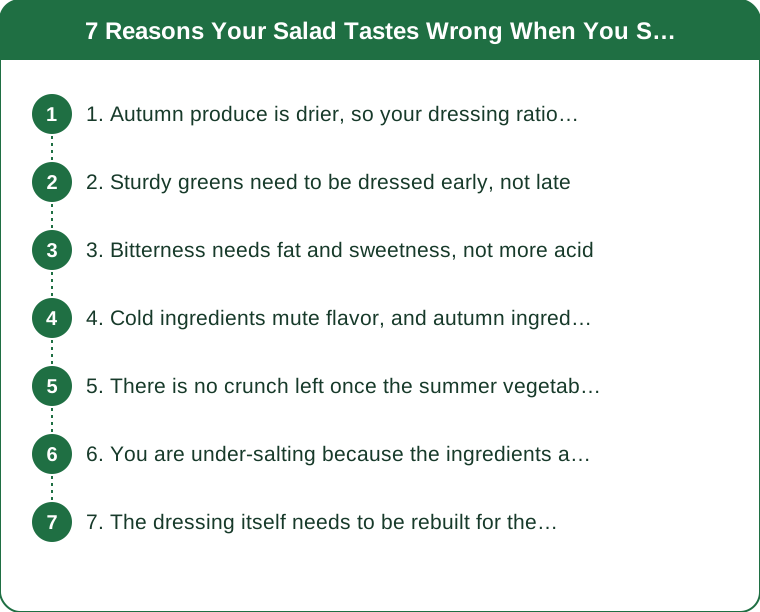
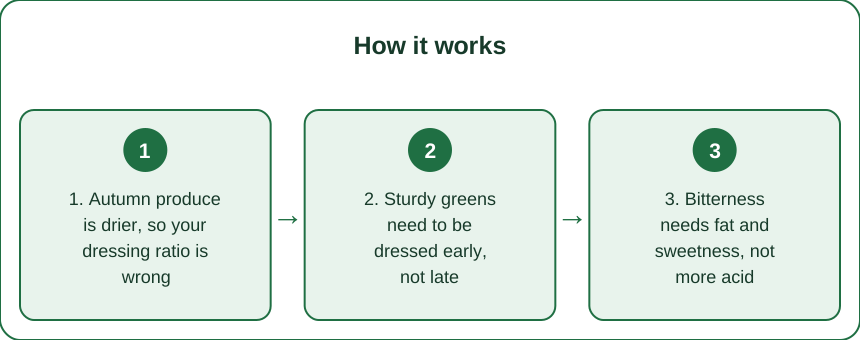
1. Autumn produce is drier, so your dressing ratio is wrong
A summer salad is mostly water. Tomatoes and cucumbers release liquid into the bowl, which dilutes the dressing and carries flavor around. A vinaigrette made for that environment is deliberately concentrated.
Autumn ingredients release almost nothing. Roasted squash, shredded cabbage, apples, and root vegetables hold their moisture, so the dressing stays exactly as concentrated as it started and coats less surface area.
Use more dressing than feels right — roughly a third more than a summer salad of the same volume — and toss for considerably longer. Thirty seconds of proper tossing distributes dressing better than adding another spoonful does.
2. Sturdy greens need to be dressed early, not late
The universal salad rule is to dress at the last moment, and it is correct for tender lettuce, which wilts on contact with acid and salt.
Sturdy autumn greens — kale, cabbage, radicchio, escarole — behave the opposite way. They benefit from sitting in dressing for ten to twenty minutes, which softens the cell walls and takes the aggressive edge off. Undressed until serving, they stay tough and taste raw.
The practical version: dress kale first, then build the rest of the salad on top while it sits. If you are combining tender and sturdy greens, dress the sturdy ones separately and fold the tender ones in at the end.
3. Bitterness needs fat and sweetness, not more acid
Radicchio, endive, kale, and Brussels sprouts are all genuinely bitter, and bitterness is the flavor most people misdiagnose. The instinct is to add lemon, which sharpens rather than softens.
Bitterness is muted by fat, salt, and sweetness. More olive oil, a proper amount of salt, and something sweet — a few slices of apple or pear, a spoonful of honey in the dressing, some dried fruit, or a caramelized element.
This is why the classic autumn combinations exist: bitter greens with blue cheese and pear, or Brussels sprouts with bacon and maple. Those are not arbitrary flavor pairings. They are bitterness management, arrived at by centuries of trial and error.

4. Cold ingredients mute flavor, and autumn ingredients are colder
Flavor perception drops significantly at refrigerator temperature. Summer salads mostly get around this because tomatoes are usually room temperature and the whole dish is eaten in a warm environment.
An autumn salad built entirely from the fridge, eaten in a cool kitchen, is being tasted at the worst possible temperature. Let components sit out for fifteen minutes before assembling, and specifically the dressing, which becomes thick and dull straight from cold and does not coat properly.
Better still, put something warm in the bowl. It does not need to be hot — just-roasted squash at room temperature, warm grains, or freshly toasted nuts all lift the entire dish.
5. There is no crunch left once the summer vegetables are gone
Cucumber, raw pepper, and crisp lettuce provide the textural contrast that makes a summer salad satisfying. Swap them for roasted vegetables and the whole bowl becomes soft, which reads as boring even when the flavor is good.
Autumn crunch has to be added deliberately. Toasted nuts and seeds, thin raw fennel or celery, apple matchsticks, croutons made from real bread, crisp fried shallots, or raw shredded cabbage.
Toasting matters more than the choice. Raw walnuts are soft and slightly bitter; walnuts toasted for six minutes are crisp and sweet. It is a five-minute step with a disproportionate effect, and it is the one people skip most often.
6. You are under-salting because the ingredients are sweet
Autumn vegetables — squash, sweet potato, carrot, beet — are noticeably sweeter than summer ones. Sweetness makes a dish taste finished before it is properly seasoned, so people stop salting too early.
Salt the components separately rather than salting the assembled bowl. Salt the roasted vegetables while hot, salt the greens as you dress them, and salt the dressing itself. Salt added to a finished salad sits on top and never distributes.
A test worth running: taste one dressed leaf on its own. If it tastes good alone, the salad will taste good. If it tastes like a vegetable with oil on it, it needs salt, not more ingredients.
7. The dressing itself needs to be rebuilt for the season
A classic summer vinaigrette runs around three parts oil to one part acid, light and sharp, built to cut through watery sweet vegetables.
An autumn dressing needs more body to cling to dry, dense ingredients. Add an emulsifier and something with weight — mustard, tahini, yogurt, miso, or a mashed roasted garlic clove. These thicken the dressing so it coats rather than running to the bottom of the bowl.
A reliable autumn base: two parts olive oil, one part apple cider vinegar, a heaped teaspoon of mustard, a teaspoon of maple or honey, and salt. Shaken hard, it emulsifies properly and holds. It handles bitter greens, roasted vegetables, and apples all at once, which is most of what the season offers.
And the timing note for right now: late August is the overlap window when both summer and autumn produce are available at the same time, which is genuinely the best salad month of the year. A bowl with late tomatoes and early squash together needs the autumn dressing, because the dense ingredient always sets the requirement.
TL;DR:
- Autumn produce releases no water, so use about a third more dressing and toss much longer
- Dress sturdy greens early and let them sit; dress tender ones at the last second
- Fight bitterness with fat, salt, and sweetness rather than with more acid
- Add crunch deliberately, salt each component separately, and rebuild the dressing with mustard or tahini for body
The summer formula is not wrong. It is calibrated for wet, mild, acidic ingredients, and autumn produce is dry, dense, and bitter — which means the same technique produces a different result until you adjust for what is actually in the bowl.
Keep Reading
This article is for general informational purposes only and is not medical advice. Always consult a qualified health professional for guidance specific to you.