7 Salad Mistakes That Happen Before You Add Any Dressing
Quick Answer: A good salad is decided by water, temperature, salt timing, texture contrast, and cut size - long before dressing enters the picture. Wet leaves refuse dressing, cold-from-the-fridge ingredients mute flavour, salt added at the wrong moment draws water out of everything, and a bowl with only one texture reads as boring no matter how good the vinaigrette is. Fix the seven below and the same dressing tastes twice as good.
Seven mistakes, in the order they happen.

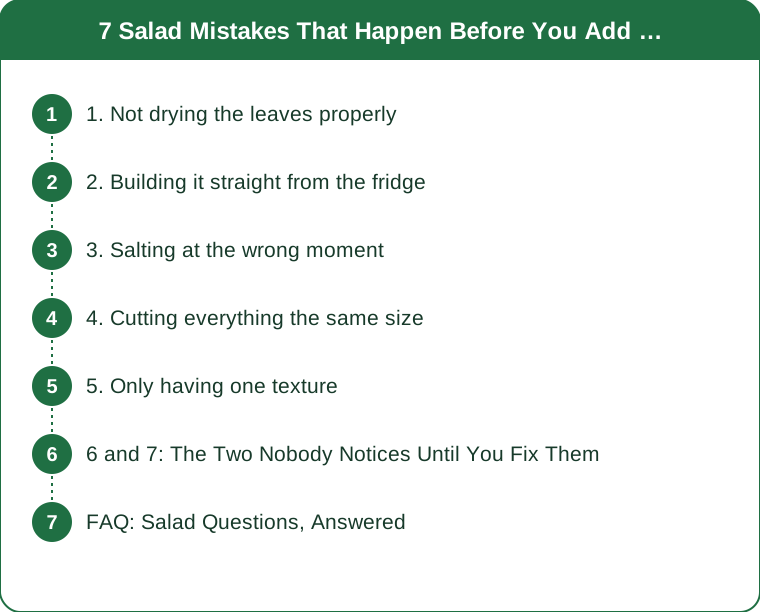
1. Not drying the leaves properly
This is the single largest one and it is almost universal. Oil and water do not mix, so dressing slides straight off wet leaves and pools at the bottom of the bowl. You then add more dressing to compensate, and end up with a heavy salad and a puddle.
Damp leaves also dilute everything. Every drop of water on a leaf thins the dressing that does eventually cling, which is why a salad can taste both over-dressed and under-seasoned at once.
A salad spinner is genuinely worth the cupboard space, but a clean tea towel works: lay the leaves out, roll gently, and pat. Aim for leaves that feel dry to the touch rather than merely not dripping.
Wash early, dry thoroughly, and store wrapped in a dry towel in the fridge. Leaves washed and dried hours ahead are drier and crisper than leaves washed at the last minute - which reverses the usual assumption that fresher-washed is better.
And do not skip drying because the leaves came pre-washed. Bagged leaves often carry surface moisture, and they are frequently the wettest leaves in the kitchen.
2. Building it straight from the fridge
Cold suppresses flavour perception. Aromatic compounds are less volatile at low temperature, so fridge-cold tomatoes, cucumber, and cheese all taste noticeably flatter than the same ingredients at room temperature.
Tomatoes are the worst affected. Refrigeration below about 12°C degrades both flavour compounds and texture in tomatoes, and the damage is not fully reversible by letting them warm up afterwards. Store them on the counter.
Take everything else out 20 to 30 minutes before assembling. Cheese, cured meat, cooked grains, roasted vegetables - all of them taste better a little above fridge temperature.
Leaves are the exception. They should stay cold and crisp, which is exactly why layering matters: cold leaves plus room-temperature everything else is the target, not a uniformly cold bowl.
And a genuinely warm element transforms a salad. Warm roasted vegetables, a just-fried egg, or warm grains over cold leaves creates a temperature contrast that reads as far more interesting than any additional ingredient would.
3. Salting at the wrong moment
Salt draws water out of vegetables through osmosis, which is useful when you want it and destructive when you do not. Salting leaves early gives you a wilted, watery bowl by the time it reaches the table.
Salt the leaves last, immediately before serving. Or better, salt the dressing rather than the salad so it distributes evenly without sitting directly on the leaf surface.
But salt some things early on purpose. Cucumber, tomatoes, and courgette benefit from being salted 15 to 20 minutes ahead and drained - you remove the water that would otherwise dilute your dressing, and the flavour concentrates.
Onions get a specific treatment. Salting and rinsing, or soaking in cold water, removes the harsh sulphur compounds that make raw onion overpowering. Ten minutes changes them completely.
And under-salting is more common than over-salting in home salads. Vegetables need more seasoning than people expect, and a salad that tastes boring is far more often under-salted than under-dressed. Taste a leaf before serving - that is the only reliable check.
One acid note that belongs here: acid behaves similarly to salt on delicate leaves. Dressing a soft-leaf salad more than a few minutes ahead produces the same wilting, which is why sturdy leaves and delicate leaves have different timing rules entirely.

4. Cutting everything the same size
A bowl where every element is the same size and shape eats monotonously, because each forkful is identical. Variation in cut is what makes a salad interesting to eat, and it costs nothing.
Vary deliberately. Some ingredients in large pieces, some fine, some shaved, some whole. Shaved fennel, halved cherry tomatoes, whole herb leaves, and finely diced shallot in the same bowl eat far better than four things all diced to a centimetre.
Cut size also changes flavour intensity. Finely chopped raw onion or garlic distributes strongly through the whole bowl; the same amount in larger pieces gives occasional intense bites with mild ones between. Both are valid, but they are different dishes.
Everything should still be fork-sized. The most common practical complaint about restaurant salads is huge uncut leaves, and it is worth avoiding at home too. Tear large leaves rather than leaving them whole.
Herbs belong as leaves, not as a garnish. Whole basil, parsley, mint, or dill leaves treated as a salad ingredient rather than a sprinkle add far more than the same herbs chopped fine - and they are the cheapest upgrade available.
5. Only having one texture
Texture contrast is what makes a salad satisfying, and it is the most commonly missing element in home salads. Soft leaves plus soft tomato plus soft cheese has nothing to bite against.
Aim for at least three textures. Something crisp, something soft, something crunchy. Crisp leaves, soft avocado or cheese, and crunchy nuts, seeds, or croutons is the standard structure for a reason.
Toast the nuts and seeds. Three minutes in a dry pan transforms both flavour and crunch, and untoasted nuts in a salad are a missed opportunity almost every time.
Add the crunchy element last, at the table. Croutons and toasted nuts soften quickly once they meet dressing. Anything crunchy added early is not crunchy by the time it is eaten.
And consider a chewy element too. Dried fruit, roasted grains, or a firmer cheese adds a fourth texture that most home salads skip entirely.
The seasonal version right now: as summer produce fades, the crisp component gets harder to source from tomatoes and cucumber. Shift toward shaved raw fennel, thinly sliced apple or pear, and toasted seeds - the same textural structure with the autumn version of each part.
6 and 7: The Two Nobody Notices Until You Fix Them
6. Dressing in the wrong vessel
Dressing in the serving bowl distributes badly. The leaves at the top get everything and the ones at the bottom get a puddle. Dress in a large mixing bowl - much larger than you think you need - and transfer.
Use your hands rather than tongs. Hands distribute a thin coating gently; tongs bruise delicate leaves and clump the dressing. This is what people are doing in restaurants when they appear to be doing nothing.
Add dressing in stages. Half, toss, taste, then add more if needed. You cannot remove dressing once it is on, and over-dressing is the failure mode you cannot recover from.
And dress from the bottom up. Pour down the sides of the bowl rather than over the leaves, then lift from underneath - this coats evenly rather than saturating whatever the stream landed on.
7. Treating the salad as a side rather than composing it
A salad with no organising idea tastes like a bowl of separate things. The good ones have a structure: a base, a substantial element, an acid, a fat, something crunchy, and something aromatic.
Missing the fat is the most common structural gap. Fat carries flavour compounds and creates mouthfeel - a fat-free salad tastes thin regardless of what else is in it. Avocado, cheese, nuts, or a proper oil-based dressing all fill it.
Missing the acid is the second most common. A salad that tastes flat and heavy usually needs lemon or vinegar rather than more salt or more dressing.
And one strong flavour anchors the bowl. Something salty, sharp, or intensely savoury - olives, capers, anchovy, a strong cheese, pickled onion. Salads without an anchor are the ones described as healthy but boring, and adding one changes the whole dish.
Build it as a dish with a point of view, not as a container for leftover vegetables. That single reframe fixes more salads than any recipe.
FAQ: Salad Questions, Answered
Why does my dressing pool at the bottom of the bowl?
Almost always because the leaves are still damp - oil will not cling to water. Dry them properly and the same amount of dressing coats far better.
When should I salt a salad?
Salt the dressing rather than the leaves, and dress immediately before serving. Salt cucumber, tomato, and courgette 15 to 20 minutes ahead and drain them, though - that is deliberate water removal.
Should I keep tomatoes in the fridge?
No. Refrigeration degrades both flavour and texture in tomatoes, and the damage is not fully reversed by warming them up afterwards.
How far ahead can I dress a salad?
Minutes for delicate leaves - acid and salt wilt them quickly. Sturdy leaves like kale or cabbage actually improve with 20 to 30 minutes of dressing time.
Why does my salad taste boring even with good dressing?
Usually a missing structural element rather than a dressing problem: no fat, no acid, no crunch, or no strong anchoring flavour. Check for those four before changing the recipe.
What is the easiest single upgrade?
Toasting your nuts or seeds for three minutes in a dry pan, and adding them at the table rather than in the kitchen.
TL;DR:
- Dry the leaves properly - oil will not cling to water, and this one fix improves every salad you make.
- Cold suppresses flavour. Leaves stay cold; everything else comes out of the fridge 20 to 30 minutes ahead. Never refrigerate tomatoes.
- Salt the dressing, not the leaves - but salt cucumber and tomato ahead deliberately and drain them.
- Vary the cut size. Same-size everything eats monotonously; shaved, diced, halved, and whole in one bowl does not.
- Three textures minimum, with the crunchy element added at the table. Toast the nuts.
- Dress in an oversized bowl with your hands, in stages, pouring down the sides and lifting from underneath.
- Compose with structure: base, substance, acid, fat, crunch, and one strong anchoring flavour. Missing fat or acid is why salads taste flat.
If it tastes healthy but boring, it needs an anchor - not more dressing.
Keep Reading
This article is for general informational purposes only and is not medical advice. Always consult a qualified health professional for guidance specific to you.