7 Salad Mistakes That Happen in the Fridge, Not the Bowl
Quick Answer: Most salad failures are storage failures. Greens wilt from moisture and ethylene exposure, herbs die from cold, and pre-cut vegetables go slimy from being stored wet in sealed containers. Fix the fridge and the bowl takes care of itself — properly stored greens last 7-10 days instead of 3.
You bought good lettuce on Sunday. By Wednesday it was limp, by Thursday it had a translucent patch, and on Friday it went in the bin.
Nothing you did at the cutting board caused that. It all happened behind a closed door.
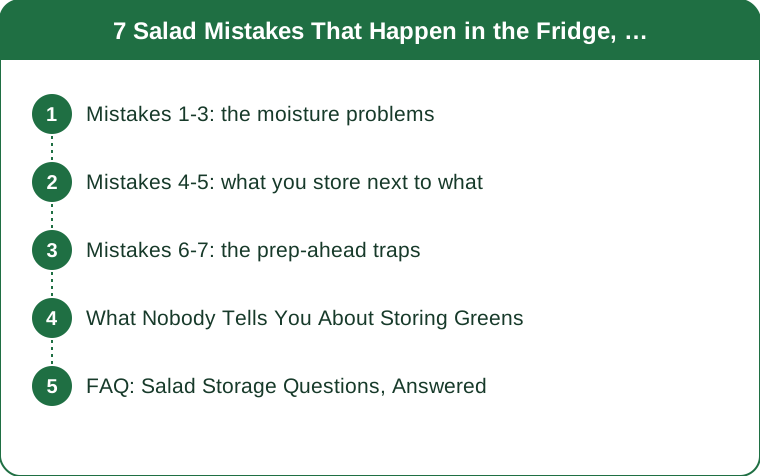
Mistakes 1-3: the moisture problems
1. Storing greens wet
This is the biggest one by a distance. Surface water on leaves accelerates cell breakdown and creates the conditions for bacterial slime. Washed-and-not-dried greens have a shelf life measured in about two days.
The fix: dry thoroughly before storage — a salad spinner, then a final pass with a clean towel. If you only change one habit from this list, change this one. Properly dried greens routinely last three times as long.
2. Sealing them airtight
Greens respire after harvest. They keep taking in oxygen and releasing carbon dioxide and moisture. In a fully sealed container that moisture has nowhere to go and condenses right back onto the leaves.
The fix: store with a paper towel inside the container, and leave the lid slightly ajar or use a container with a vent. The towel absorbs the condensation, and swapping it on day three roughly doubles remaining life.
3. Storing them in the coldest spot
Most fridges run coldest at the back of the bottom shelf, and lettuce actually suffers there. Leaves freeze at around 31°F, and partial freezing ruptures cell walls — that translucent patch on your romaine is freeze damage, not age.
The fix: the crisper drawer exists for this reason. Set it to high humidity for leafy greens, and keep the coldest zone for dairy and meat.
Mistakes 4-5: what you store next to what
4. Putting greens near ethylene producers
Apples, pears, tomatoes, avocados, peaches, and bananas release ethylene gas as they ripen. Leafy greens are highly sensitive to it — ethylene exposure causes russet spotting on lettuce and accelerates yellowing in spinach and herbs.
The fix: two crisper drawers with a job each. One set to low humidity for ethylene producers (the vent lets the gas escape), one on high humidity for greens and herbs. If you only have one drawer, keep the apples out of it entirely — the counter is better for them anyway.
5. Refrigerating herbs like they are lettuce
Basil, in particular, hates the fridge. Below about 50°F it develops black spots within a couple of days, which is chilling injury rather than spoilage. Mint, parsley, cilantro, and dill are all fine cold, but basil is not.
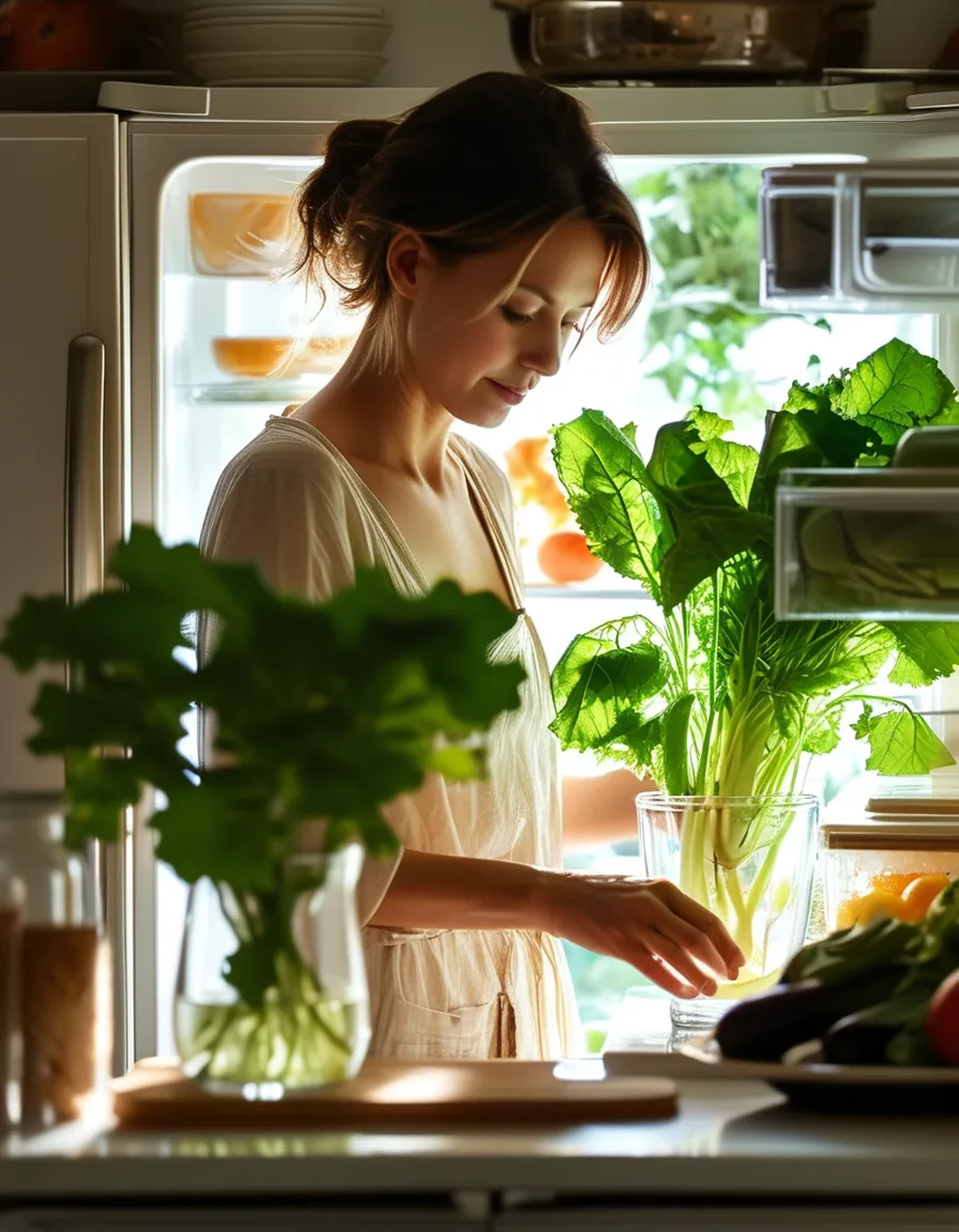
The fix: basil goes in a glass of water on the counter, loosely covered, like flowers. Hardy herbs (rosemary, thyme) wrap in a barely damp towel in the fridge. Soft herbs (parsley, cilantro) go stems-down in a jar of water with a bag over the top — that method reliably gets three weeks out of a bunch that would otherwise last five days.
Mistakes 6-7: the prep-ahead traps
6. Cutting everything on Sunday
Cut surfaces oxidize, lose moisture, and leak sugars that feed bacteria. A whole cucumber lasts a week; a sliced one lasts two days. The prep-ahead instinct is good, but applied indiscriminately it shortens the life of everything in the container.
What to cut ahead: carrots, celery, peppers, red onion, radishes, cabbage, broccoli, hard cheese. These hold up genuinely well for 4-5 days.
What to cut the day of: cucumber, tomato, avocado, apple, pear, soft herbs, anything leafy that will be dressed.
7. Layering a jar salad wrong
The jar method works, but only if the order is right. The failure everyone has had is opening a jar to find the bottom third is soup.
The correct order, bottom to top: dressing, then hard vegetables (carrot, pepper, onion), then grains or beans, then proteins and cheese, then soft vegetables, then greens at the very top. The hard layer acts as a barrier so the dressing never touches the leaves.
Packed that way, a jar salad holds for 4-5 days. Packed with the greens anywhere near the bottom, it holds for about one.
What Nobody Tells You About Storing Greens
Bagged salad has already been washed and gassed. Most pre-washed bags are packed in a modified atmosphere with reduced oxygen. Once you open the bag, that protection is gone and the clock speeds up dramatically. Transfer opened bagged salad to a towel-lined container rather than clipping the bag shut.
Whole heads outlast leaves by a lot. A whole head of romaine keeps for two weeks. The same lettuce separated into leaves keeps for four days. Every cut surface is a place where deterioration starts, which is why buying whole and separating as you go beats buying pre-cut on both cost and life.
Reviving wilted greens actually works. Fifteen to thirty minutes in ice water restores turgor in leaves that have lost moisture but not broken down. It does not save slimy or yellowed greens, but it rescues a lot of lettuce that would otherwise have been thrown out. Dry thoroughly afterward.
The crisper humidity slider is not decorative. High humidity (vent closed) traps moisture around things that wilt: greens, herbs, cucumbers, peppers. Low humidity (vent open) lets ethylene escape from things that rot: apples, pears, stone fruit. Most people never touch it and lose meaningful shelf life to that one setting.
Cold ruins tomato flavor permanently. Below about 55°F, the enzymes producing tomato aroma compounds shut down and do not fully restart when the tomato warms up. Store tomatoes on the counter, and if a salad tastes flat, this is often the reason.
FAQ: Salad Storage Questions, Answered
How long should washed greens actually last?
Properly dried and stored in a vented container with a paper towel, 7-10 days for sturdy greens like romaine and kale, 5-7 for spinach, and 4-5 for delicate mixes and arugula. If yours are dying at day three, moisture is nearly always the cause.
Is it worth buying a salad spinner?
For anyone eating salad more than once a week, yes — it is the single highest-return tool for this. Towel drying works but never gets leaves as dry, and the difference in shelf life between well-dried and mostly-dried is measured in days, not hours.
Can I store dressing with the salad?
Only with a physical barrier between them, as in the jar method. Dressing draws water out of leaves through osmosis and breaks them down within an hour or two. Dressed leftover salad is not really salvageable, which is why dressing at the table rather than in the bowl matters for anything you might not finish.
TL;DR:
- Dry greens completely before storing — wet storage is the number one cause of a three-day lifespan.
- Vent the container and add a paper towel; sealed airtight is worse than slightly open.
- Keep greens in a high-humidity crisper, away from apples, pears, and tomatoes.
- Basil belongs on the counter in water, not in the fridge.
- Cut hard vegetables ahead, cut soft ones the day of, and layer jar salads with dressing at the bottom under hard vegetables.
The change worth making this week is the smallest one: spin the greens dry, line the container with a paper towel, and leave the lid loose. It takes ninety seconds on shopping day and it is the difference between a bag of lettuce that becomes four salads and one that becomes two salads and some regret.
Keep Reading
This article is for general informational purposes only and is not medical advice. Always consult a qualified health professional for guidance specific to you.