9 Reasons Your Homemade Salad Goes Soggy by Lunch
Quick Answer: Sogginess comes from water moving out of vegetables and into the leaves, driven by salt, acid, cut surfaces, and residual wash water. The fixes are drying the greens thoroughly, keeping dressing separate or at the bottom, salting nothing until serving, and layering wet ingredients away from the leaves. Do those four and a salad packed at 7am is still crisp at noon.
Restaurant salads are assembled seconds before they reach you. Yours has five hours in a container, which is a completely different engineering problem.

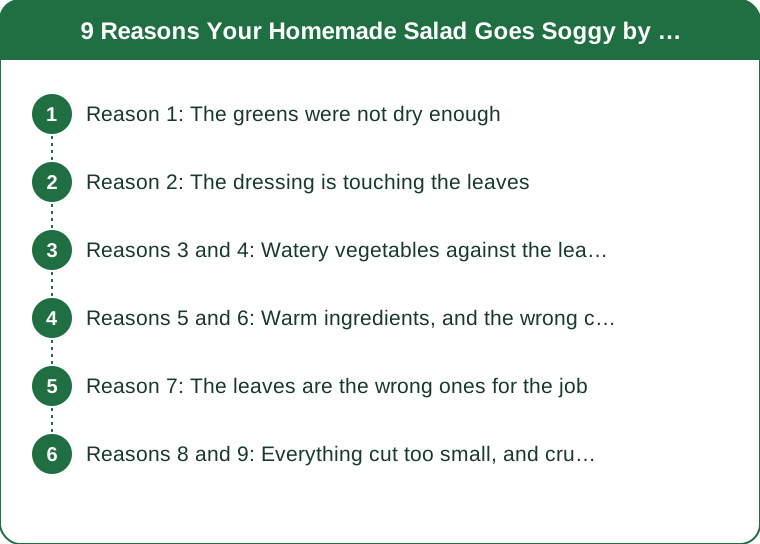
Reason 1: The greens were not dry enough
The single biggest cause, and the one most people underestimate.
Washed greens hold a surprising amount of surface water. That water sits between the leaves, softens them over hours, and dilutes anything else in the container.
A salad spinner removes far more than shaking in a colander does, and it is the most useful single tool for this problem. After spinning, a further pass with a clean towel or paper towel removes what remains.
The fix: spin, then pat, then let them sit for a few minutes uncovered before packing. Greens that feel dry to the touch, not just less wet, are the target.
A related habit: store washed greens with a dry paper towel in the container. It absorbs moisture released over the following days and keeps the whole bag crisp considerably longer. Replace it when it feels damp.
If you buy pre-washed bagged greens, they are usually drier than home-washed ones and can go straight in, which is a genuine advantage of the format.
Reason 2: The dressing is touching the leaves
Dressing does two things to a leaf: the oil coats it and the acid and salt draw water out of it.
The salt in a dressing pulls moisture from the leaf cells through osmosis, which is exactly the process used deliberately to wilt vegetables when you want them soft. Acid contributes by breaking down cell walls.
So dressing on greens is a wilting mechanism operating slowly for as long as they are in contact.
The fix: dressing in a separate small container, added at the table. If separate containers are impractical, dressing goes in the very bottom of a jar with the sturdiest ingredients above it, and the jar is not shaken until serving.
The jar-layering approach works well: dressing at the bottom, then hard vegetables like carrot and cucumber, then grains or beans, then protein, then softer items, with leaves at the very top away from everything.
One exception worth knowing: sturdy leaves like kale and cabbage actually improve with an hour or two in dressing, because the softening is desirable. A massaged kale salad is better at noon than it was at seven.
Reasons 3 and 4: Watery vegetables against the leaves, and salt added too early
Both are extremely high in water and both release it readily once cut.
A cut tomato loses liquid continuously, and the seeds and surrounding gel are the worst offenders. Cucumber does the same, particularly when sliced thin.
Against greens, that released liquid does exactly what dressing does.
The fix: seed the tomatoes, or use a firmer variety, and pack them in a separate compartment or at the bottom of the layering. For cucumber, salting and draining before packing removes much of the water in advance, though it also softens the cucumber, so it is a trade.
Cherry tomatoes left whole release almost nothing, which makes them the best choice for a packed salad by a wide margin. Halving them is the point at which the problem starts.
Same principle applies to any wet fruit: orange segments, berries, and melon all release liquid and all belong in their own space.
Reason 4: Salt was added too early
Salt on any vegetable starts drawing water out immediately.
This matters most for anything you salt for flavor at assembly time, and it is a habit people carry over from cooking, where salting early is usually correct.
The fix: salt at serving, never at packing. If a component genuinely needs salting in advance, such as cucumber you intend to drain, do it deliberately and drain it properly before it joins anything else.
This extends to salty ingredients too. Feta, olives, capers, and cured meats all release brine, and all of them are better in a separate compartment or on top rather than mixed through.
A useful reframe: a packed salad has two stages, storage and serving. Anything that changes texture belongs in the serving stage. That includes salt, dressing, acid, and anything crunchy.

Reasons 5 and 6: Warm ingredients, and the wrong container shape
Anything added warm creates condensation inside a sealed container, and that condensation lands on the leaves.
Roasted vegetables, cooked grains, and cooked protein are all common culprits. A container sealed with warm rice inside will have visible water on the lid within an hour, and all of it ends up on the salad.
The fix: cool everything completely before packing, spread out on a tray or plate rather than piled in a bowl, which cools much faster.
If time is short, a few minutes in the fridge uncovered does more than twenty minutes on the counter covered.
This is also a food safety point rather than only a texture one. Cooked food should move through the temperature range where bacteria multiply fastest reasonably quickly, and sealing warm food in a container slows that considerably. Cool it, then seal it, then refrigerate.
Reason 6: The container is the wrong shape
A wide, shallow container packs a salad in a thin layer, which means the leaves at the bottom carry the weight of everything above them and sit in whatever liquid collects.
A taller container, or a jar, lets you layer vertically so that the leaves sit at the top, above the liquid line, with nothing pressing down on them.
The fix: use a container with some height, and layer rather than mix. Jars work well for exactly this reason and not because of any aesthetic quality.
Compartmented containers solve it differently and arguably better, since nothing needs to be layered carefully and everything stays separate until you combine it.
Also worth considering: how full the container is. A container packed tightly compresses the leaves, and compressed leaves bruise and release liquid. Leaving some air space genuinely helps, which is counterintuitive when you are trying to fit lunch in a bag.
Reason 7: The leaves are the wrong ones for the job
Not all greens hold up equally, and the difference is dramatic.
Best for packed salads: romaine, kale, cabbage, radicchio, and endive. Thick cell walls, low surface area relative to mass, and genuine structure.
Middle: spinach and mixed baby leaves. Fine for a few hours if kept dry and undressed, gone by the next day.
Worst: butter lettuce, mache, and delicate herbs. Wonderful fresh, structurally hopeless after four hours in a container.
The fix: build packed salads on a sturdy base and add the delicate leaves and herbs at serving if you want them. A romaine and cabbage base with a handful of soft herbs added at the table gives you both the structure and the flavor.
Shredded cabbage is genuinely underrated here. It stays crisp for days, takes dressing well, and provides the crunch that a wilted salad has lost.
Reasons 8 and 9: Everything cut too small, and crunchy elements packed too early
Cutting creates surface area, and surface area is where water escapes and where things get soft.
Finely diced vegetables release far more liquid than larger pieces of the same vegetable, and they lose texture faster.
The fix: cut larger for a packed salad than you would for one eaten immediately. Chunks rather than dice, thick slices rather than thin.
This applies especially to anything watery. A thick slice of cucumber holds together; a thin one becomes translucent within hours.
Related: tear leaves rather than cutting them where practical. Cut edges on lettuce brown faster than torn edges, because cutting damages a wider band of cells along the edge. The difference is modest but visible over a full day.
Reason 9: The crunchy elements went in at the start
Nuts, seeds, croutons, crispy chickpeas, and fried onions all absorb moisture from the air inside the container, and they do it quickly.
By lunch, croutons packed at seven are soft, and soft croutons contribute nothing except calories.
The fix: a small separate container, or a fold of foil, or simply keeping a jar of nuts at work and adding them at the table. This is the easiest of all nine fixes and the one most often skipped.
The same applies to anything you want to stay crisp: crispy fried shallots, tortilla strips, wonton crisps, and toasted seeds.
FAQ: Salad Packing Questions, Answered
How far ahead can I actually make salads? With a sturdy base, separate dressing, and separate crunchy elements, three to four days in the fridge is realistic. With delicate leaves and mixed dressing, a few hours.
Do I need a salad spinner? It is the single most useful tool for this, and there is no equally effective substitute. Rolling greens in a clean towel works reasonably but takes longer and uses more towels.
Should I store cut vegetables in water? Carrots and celery, yes, and it keeps them noticeably crisper. Most other vegetables, no, since they absorb water and go limp or lose flavor.
TL;DR:
- Spin and pat greens genuinely dry; residual wash water is the biggest single cause
- Keep dressing, salt, and acid away from the leaves until serving
- Layer vertically with wet ingredients at the bottom and leaves on top, in a container with height
- Build on romaine, cabbage, or kale, cut everything larger, and add crunchy elements at the table
Put your dressing in a separate small container tomorrow and change nothing else. That single change fixes more than half of it.
Keep Reading
This article is for general informational purposes only and is not medical advice. Always consult a qualified health professional for guidance specific to you.